

Agencies use “designer” and “developer” as if they meant the same job. The website design vs website development split matters less to a Walsall builder who wants the phone to ring than to the agency, but knowing who does what helps you read a quote and call the right person when something breaks.
This guide covers what a web designer does, what a web developer adds, UK costs, and two problems owners ask about most: “Not secure” warnings and restricted sites. Our web design services page shows what a build includes.
Short answer: web design vs web development comes down to looks versus workings. Web design plans how a site looks, reads and guides visitors towards getting in touch. Web development writes the code, connects the database and keeps the site fast and secure. Most small business websites need both, ideally from one accountable person or team.
Website design vs website development: what’s the actual difference?
Website design is the planning of what a visitor sees and does on each page, while website development is the technical work that makes those pages load, function and stay online.
Ask what failed. If visitors can’t find your prices, the layout or visual hierarchy isn’t steering them: a web design fault. If they find the prices but the quote form never reaches your inbox, the server or the form submissions handler is at fault, and that’s web development.
Web design vs development is also a split in tools. Designers work in Figma, Sketch or Adobe XD before anyone writes code; developers build inside a content management system such as WordPress, one of several CMS platforms. Neither of the two disciplines is more important.
The table below puts the two roles side by side.
| Point | Web design | Web development |
|---|---|---|
| Question it answers | How should this look and guide people? | How does this work every time? |
| Typical output | Sitemap, page mockups, style guide | Live pages, forms, third-party integrations |
| Common tools | Photoshop, Illustrator | Code editor, frameworks |
| Core skills | Typography, colour scheme, usability | Performance, security, responsiveness |
| What failure looks like | Confusion, low conversions | Slowness, errors, missing functionality |
What is a web designer, and what do they actually do?
A web designer is the person who turns a business’s goals into page layouts, visual styles and routes through the site that a developer can build and a customer can follow.
The National Careers Service lists talking with clients, building prototypes, checking accessibility and analysing visitor data as core tasks. Good designers map user journeys from first click to enquiry, because user experience is measured in calls and forms. Designers judge buttons by whether people press them.
Balance, contrast, emphasis, consistency and unity decide whether a Solihull salon’s site feels premium or patched together, while fonts, colour palettes and hover button states carry the branding from shop sign to screen. Creativity matters, but the look and feel should make “book” or “call” the obvious next step.
How do web designers work on a project?
Web designers usually work in a fixed order, moving from understanding the business to a signed-off visual design before the build starts.
On a typical small business project, the stages run like this:
- Brief: agree goals, audience and requirements, with planning for how many pages you need.
- Sitemap: plan the information structure so every service has its own page.
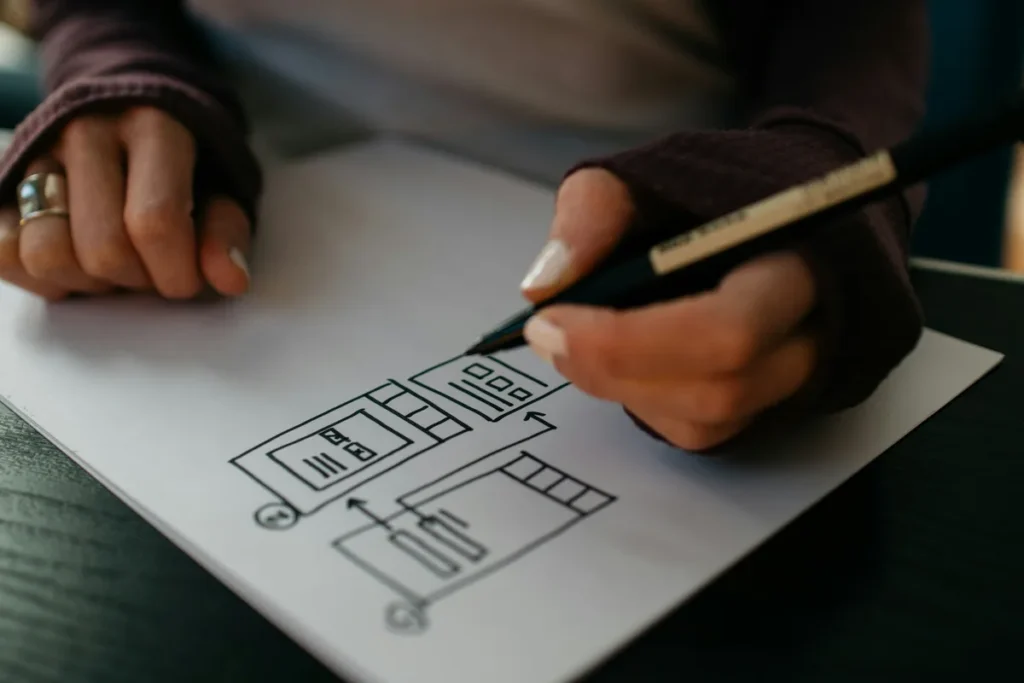
- Wireframes: grey-box page plans that fix the content order before colour arrives.
- Visual design: apply the brand, image editing and visual elements, then share drafts for feedback.
- Build hand-off: pass approved designs, graphics and notes to the developer.
Design comes first, and a clear sign-off at stage 4 stops expensive rework. A careful designer also checks the user flow on a phone, where many customers see the site first.
How many hours do web designers work?
Web designers in the UK typically work 37 to 42 hours a week, according to the National Careers Service, usually flexibly between 8am and 6pm.
The same profile puts salary at about £28,000 for a starter and £50,000 for an experienced designer. Designers who go freelancing set their own hours, though launch weeks often run long.

What does a web developer do that a designer doesn’t?
A web developer writes and maintains the code that makes a website work, from what appears on screen to the data stored behind it.
Front-end work turns designs into HTML for structure, CSS for styling and JavaScript for menus, carousels and form checks. Designers supply visual assets; front-end developers make them behave on every screen size.
Back-end work covers what visitors never see: databases, user accounts, payments and booking connections. On WordPress, that layer is mostly PHP. Back-end code is about logic and system structure, and scalability matters if you plan to add 50 products next year.
Developers also own page speed, updates, backups, functionality checks and testing on different devices, built for easy maintenance. When a plugin update breaks a contact form at 11pm, the developer fixes it, or the team behind a website maintenance plan does. If an old site breaks every month, website redesign services can be the cheaper fix.
Website, webpage or web application: which one are you buying?
A website is a set of linked pages under one domain that mainly informs visitors, while a web application is software that runs in the browser and lets users complete tasks such as logging in or booking.
Website vs web site is only a spelling difference. Website vs webpage is part versus whole: your homepage and boiler repair page are each a webpage, and together they make the website.
Website vs web application is the comparison that changes the price. A Birmingham plumber’s brochure site needs clear pages and a working enquiry form. A customer portal with logins and job tracking is a web application, built on application logic, server-side code and dynamic features, closer to software engineering than design.
The comparison below shows how the three differ.
| Webpage | Website | Web application | |
|---|---|---|---|
| What it is | One page, one address | Linked pages on one domain | Interactive software in the browser |
| Main job | Answer one question | Inform and win enquiries | Let users complete tasks |
| Example | A boiler repair page | A plumber’s 7-page site | A client booking portal |
| Where the work sits | Content and design | Design and development | Mostly development |
Website vs application usually means a site versus a phone app; for most local service firms, a fast mobile site does the job.
Which web design company do you need: designer, developer or both?
For most small businesses, the simplest choice is one web design company that covers design and development, so one person answers for the result.
A freelance web designer plus a separate developer can suit a firm with in-house marketing teams, but a sole trader ends up refereeing two people. Integrated teams avoid that, because the designer knows the builder’s constraints.
One of the common misconceptions is that you should commission the design, then hand over the design files to a builder. On small sites, each handover loses detail, and conversion tracking is usually the first casualty. A custom website works best when one agency, or one designer and developer, owns it from concept to launch, creative assets included.
Owners searching which web design company rarely need a famous name. Ask these questions before you sign:
- Who designs and who builds? Named people, not “the team”.
- Who is my main contact? One person who answers for the site.
- What happens after launch? How long support lasts.
- What can I edit myself? Pages you can change without paying.
At Anchor Web Agency, founder Nouman Sajjad handles design, development and SEO strategy himself, with trusted collaborators for specialist graphic design, and stays your main contact. Prefer to meet face to face? See how we run web design Birmingham projects.

From experience
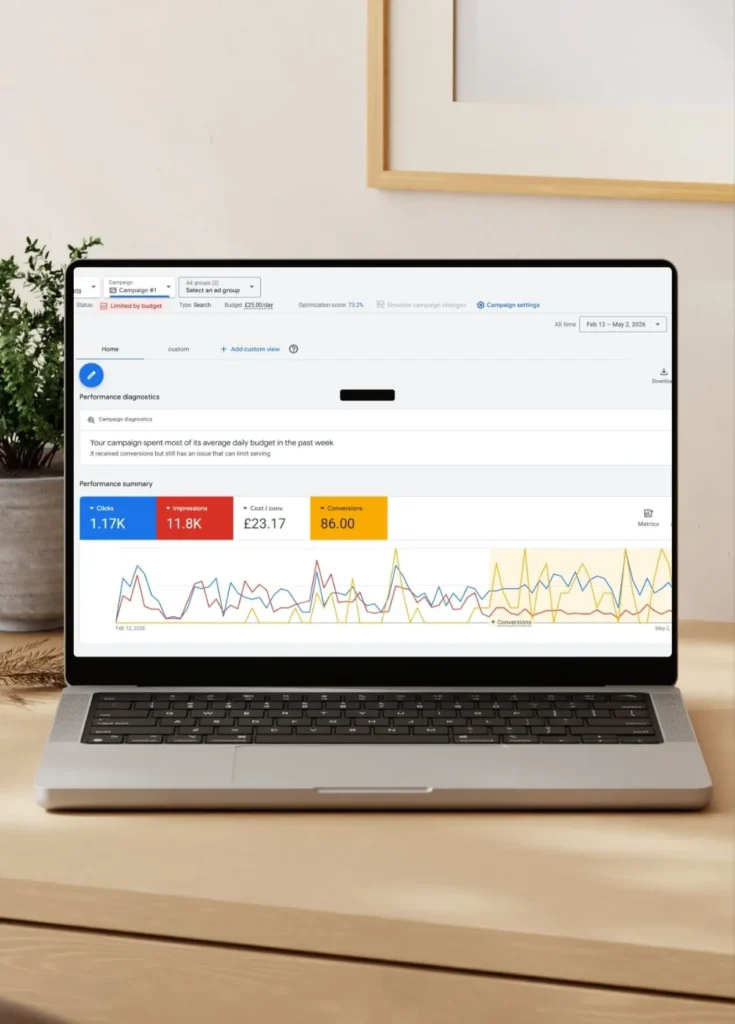
Prestige Painting Solutions, a Manchester decorator, got a new site, local SEO and Google Ads from one team. Between 12 February and 1 May 2026 that brought 81 leads in 12 weeks at £23.97 per lead, and 33+ became paying customers. Read how a Manchester painter got 81 leads in 12 weeks.
Nouman Sajjad, Founder
What is the cost of building a website in the UK?
The cost of building a website in the UK depends mainly on how much custom development it needs, and Anchor’s small business packages cost £499, £799 or £999, all excluding VAT.
Quotes for the cost of building a website uk vary widely, mostly because of development. Design is often less expensive to hire, and on simple sites that holds. On complex sites the budget goes on payments and bookings, while ready-made themes cut cost but limit customisation. Set your priorities before asking web professionals to quote.
Our small business website design range starts with the Starter Business Website (£499): 3 to 5 pages with 30 days of support. The Professional Business Website (£799) covers 7 to 14 pages, a year of free hosting and 90 days of support. Custom Website Design (£999) is fully custom, with unlimited pages and 90 days of support. All three include a mobile-responsive WordPress build, SSL, Search Console and Analytics set-up and an SEO foundation.
Most builds take 7 to 21 days, and a 3-day fast-delivery option is quoted on request. See our pricing, or compare routes in how much a website costs. Selling online? Our ecommerce website design packages run from £499 to £1,199 plus VAT, and WooCommerce vs Shopify helps you pick a platform.

Why is my website saying “Not secure” or showing as restricted?
A website shows “Not secure” when the browser can’t load it over a valid HTTPS connection, and it shows as restricted when Google, a network filter or the host has blocked it; both are development problems.
Why is my website not secure?
Your website says “Not secure” because a page loads over plain HTTP, the SSL certificate has expired or doesn’t match the domain, or the page pulls in mixed content.
Chrome has marked every HTTP page “not secure” since Chrome 68 in July 2018. If you’re asking why is my website not secure, renew the SSL certificate, force HTTPS with a 301 redirect and update the WordPress site address. Owners still asking why is my website saying not secure after that usually have mixed content: images or scripts loading over http:// on a secure page. Google’s web.dev guidance says most browsers block active mixed content such as scripts by default, which can break sliders in the browser.
Why is my website restricted?
A website is usually restricted because Google has detected a security issue, a workplace or school filter has blocked its category, or the host has suspended the account.
If you’re wondering why is my website restricted and visitors see “Deceptive site ahead”, Google Safe Browsing has flagged it. The Security Issues report in Google Search Console groups problems into hacked content, malware and unwanted software and social engineering. Fix every affected page, then select Request Review; Google says reviews typically take a few days to a few weeks.
If the site only fails on office Wi-Fi, ask the filter provider to recategorise it; if a hosting message appears everywhere, call your host. Act fast either way: plain HTTP traffic is exposed to on-path attacks.
Frequently asked questions
Will a website help my business?
A website helps a small business when it gives customers a clear reason to get in touch, an easy way to do it, and a way to find you through search or ads. A site that nobody can find, or that hides the phone number, helps no one. A user-friendly, cohesive and high-performing website shapes brand perception and turns visitor numbers into customer engagement and business growth.
Are web designers still in demand?
Web designers are still in demand in the UK for businesses that want more than a template, though the work has shifted towards conversion and accessibility standards. Website builders, drag-and-drop editors and no-code tools now handle basic layouts, so clients pay for design principles, judgement and an eye on design trends. Career paths include lead web designer. No official figure measures demand directly.
How do you become a web designer in the UK?
You can become a web designer in the UK through a degree or HND, a T Level in Digital Software Development, or an apprenticeship, according to the National Careers Service. Every route needs a portfolio. Basic programming languages help too, because design and development skill sets overlap.
How do web designers get clients?
Web designers get most clients through referrals, sample sites of live work, local search visibility and agency partnerships. Many who move into self-employment or contracting partner with agencies first. Anchor grew the same way: clients asked for more than a website, so SEO, ads, logos and social media now sit under one roof.
How many web designers are there in the world?
No official source counts how many web designers there are in the world. Statistics agencies group web design with other digital jobs, and many designers work freelance or under UI/UX or graphic designer titles. Treat any worldwide figure online as an estimate.
How many small businesses have websites?
ONS figures show 81.4% of UK businesses with 10 to 49 employees had a website in 2019, in the ONS E-commerce and ICT activity bulletin published on 5 February 2021. No matching figure was published for the smallest firms, which matters: GOV.UK estimates 5.7 million UK private sector businesses at the start of 2025, and 75% employ no one besides the owners.
Does my website have Google Analytics?
You can check whether your website has Google Analytics by opening the Realtime report in your GA4 property while you browse the site; visits appear within minutes if the Google tag works. Tag Assistant shows which tags fire, and a measurement ID starting “G-” in the page source suggests the tag is present. Every Anchor website package includes Analytics set-up, so website data starts on launch day.
Can one person do both web design and web development?
One person can do both web design and web development, and many small business websites are built that way on WordPress. A full-stack developer with design training, or a designer who codes, can cover the whole job. Ask to see live sites that load quickly, not just screenshots.
Not sure whether your site needs a designer, a developer or both? Tell us what it needs to do and we’ll reply within 24 hours with a clear price. Get a free quote or WhatsApp us on +44 7399 036995.