

You’ve decided to sell online. Maybe you’re launching your first shop, or maybe you’ve outgrown a marketplace like Etsy or eBay. Either way, you’ve landed on the same question every UK small business owner faces: should you build your online shop on WooCommerce or Shopify?
Ask 10 different agencies and you’ll get 10 different answers. The problem? Most of them only build on one platform. Shopify partners push Shopify. WordPress agencies push WooCommerce. You end up getting advice that suits their business, not yours.
At Anchor Web Agency, we build on both platforms. We’ve launched WooCommerce shops for jewellery brands and Shopify stores for fashion retailers. As a result, the advice here isn’t biased toward either platform. It’s based on what actually works best for UK small businesses in 2026.
The Short Answer
WooCommerce is better for UK small businesses with fewer products, tighter budgets, and a need for content alongside their shop. Shopify is better for product-heavy stores with larger catalogues and higher traffic. Both platforms can sell effectively. The right choice depends on your product range, budget, and how much you want to manage yourself. Professional eCommerce websites on either platform start from £499 at Anchor Web Agency.
WooCommerce and Shopify: The Fundamental Difference
Before comparing features, it helps to understand how these two platforms actually work. They take completely different approaches to the same problem.
WooCommerce is a free plugin that turns any WordPress website into an online shop. You install it on your own hosting, choose your own theme, and add plugins for extra features. You own everything. You control everything. However, you’re also responsible for everything: hosting, security, updates, and maintenance.
Shopify is an all-in-one hosted platform. You pay a monthly subscription and Shopify handles the hosting, security, software updates, and technical infrastructure. It’s simpler to set up and manage, but you have less control over customisation and you’re locked into their ecosystem.
Think of it like this. WooCommerce is like buying a house. You own it outright and can renovate however you like, but you’re responsible for the roof, the plumbing, and the electrics. Shopify is like renting a fully serviced flat. Someone else handles the maintenance, but you can’t knock down walls.
Pricing: What Each Platform Actually Costs UK Businesses
This is where most comparison articles get vague. Here’s what you’ll realistically pay in the UK in 2026.
WooCommerce Costs
The WooCommerce plugin itself is free. However, the total cost of running a WooCommerce store includes:
- Hosting: £30 to £150 per year for shared hosting. £100 to £300+ per year for managed WordPress hosting (recommended)
- Domain name: £10 to £20 per year
- SSL certificate: Usually included with good hosting
- Premium plugins: £0 to £200+ per year depending on what you need (payment gateways, shipping calculators, booking systems)
- Theme: £0 to £60 for a premium theme
- Maintenance: £29+ per month if professionally managed
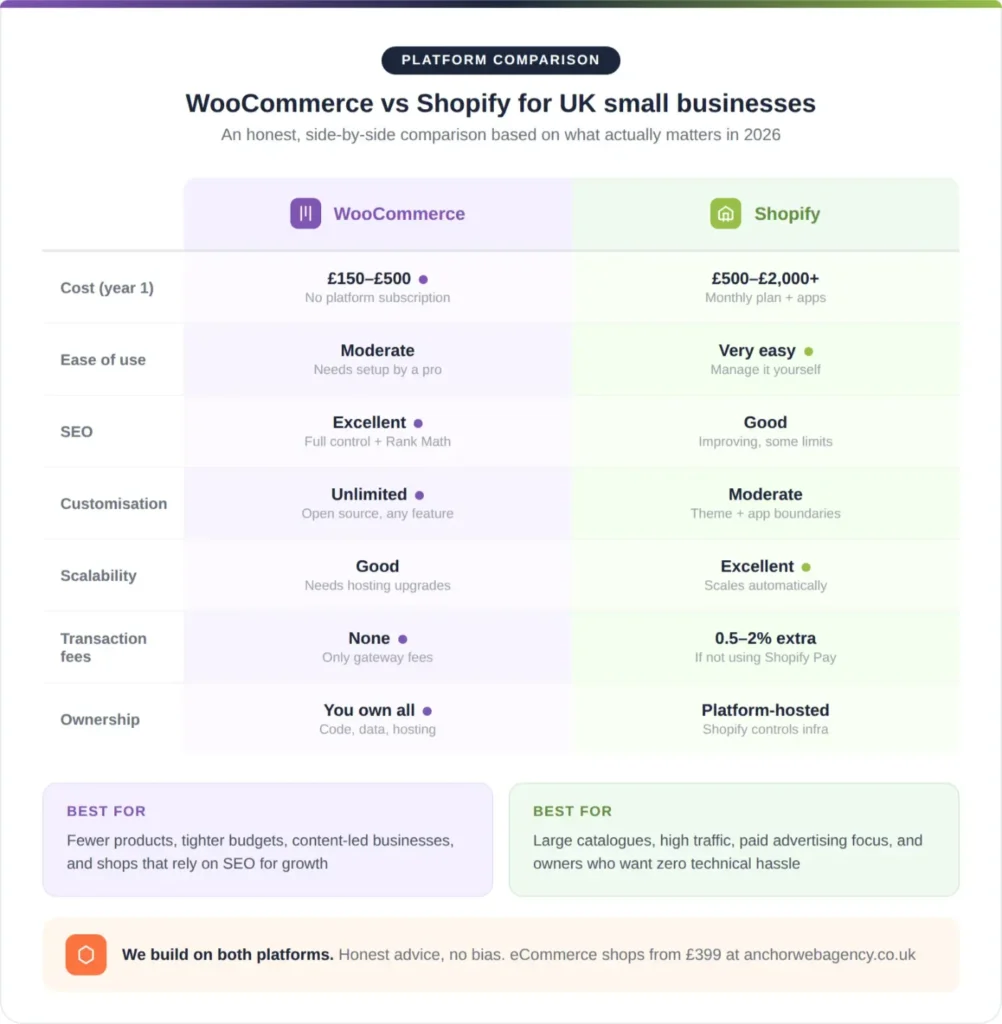
Typical first-year cost (self-managed): £150 to £500 Typical first-year cost (professionally built and managed): £500 to £1,500
The key advantage? No monthly platform subscription and no transaction fees beyond what your payment gateway charges. For small shops with fewer products and lower traffic, WooCommerce is often the most cost-effective option over two to three years.
Shopify Costs
Shopify bundles everything into a monthly subscription:
- Basic plan: £25 per month (£300 per year)
- Shopify plan: £65 per month (£780 per year)
- Advanced plan: £259 per month (£3,108 per year)
On top of the subscription, you may pay for:
- Apps: £5 to £50+ per month each (many stores need three to five paid apps)
- Transaction fees: 0.5% to 2% per transaction if you don’t use Shopify Payments
- Theme: £0 to £300+ for premium themes
Typical first-year cost: £500 to £2,000+ depending on plan and apps
The key advantage? Predictable, bundled pricing. No worrying about hosting, security patches, or server performance. For product-heavy stores with regular traffic, Shopify’s managed infrastructure removes a lot of headaches.
Important UK-specific note: If you use a third-party payment gateway instead of Shopify Payments, Shopify charges an additional transaction fee of 0.5% to 2% on every sale. For a business processing £5,000 per month, that’s an extra £25 to £100 on top of your normal card processing fees. This catches many UK businesses off guard.
Ease of Use: Which Is Simpler to Manage Day to Day?
Shopify wins for simplicity. The dashboard is clean, intuitive, and designed for non-technical people. Adding products, managing orders, updating stock levels, and processing refunds are all straightforward. Most business owners can manage their Shopify store without any technical help.
WooCommerce has a steeper learning curve. Because it runs on WordPress, you’re dealing with a more complex dashboard. Plugin updates, theme compatibility, and occasional technical issues require either some WordPress knowledge or professional support.
That said, once a WooCommerce store is properly set up by a professional, the day-to-day management of adding products and processing orders is straightforward. The complexity is mostly in the setup and ongoing maintenance, not in the daily use.
Our recommendation: If you want to manage everything yourself with zero technical knowledge, Shopify is the easier choice. If you have a professional agency handling setup and maintenance, WooCommerce’s daily management is perfectly manageable.
SEO: Which Platform Ranks Better on Google?
This matters enormously for UK businesses relying on organic search traffic to find customers.
WooCommerce has the edge for SEO. Because it runs on WordPress, you get access to powerful SEO plugins like Rank Math and Yoast SEO. You have complete control over URL structures, meta data, schema markup, heading hierarchies, and site architecture. WordPress is also the strongest platform for content marketing: blog posts, guides, and resource pages that drive organic traffic sit alongside your shop naturally.
Shopify’s SEO has improved significantly but still has limitations. URL structures are less flexible (Shopify forces “/collections/” and “/products/” into your URLs). Built-in blogging is functional but basic compared to WordPress. Technical SEO control is more limited.
For UK businesses that plan to use SEO and content marketing to drive sales, WooCommerce paired with WordPress gives you a meaningful advantage. For businesses relying primarily on paid advertising or social media, Shopify’s SEO capabilities are more than adequate.
Customisation: How Flexible Is Each Platform?
WooCommerce offers virtually unlimited customisation. Any design is possible. Any feature can be built or added via plugins. Custom product types, complex shipping rules, subscription models, membership areas, booking systems — if you can think it, WooCommerce can do it.
Shopify is more constrained. You can customise within boundaries using themes and the built-in editor. For deeper changes, you need Shopify’s Liquid templating language or paid apps. Most UK small businesses find Shopify’s customisation sufficient for standard online shops, but more complex requirements may bump into limitations.
Our take: If your shop does something unusual (custom product configurations, complex pricing tiers, or tight integration with existing business systems), WooCommerce gives you the freedom to build it. If you’re selling straightforward products with standard variations, Shopify handles it brilliantly without the complexity.
UK Payment Gateways: Stripe, PayPal, and Klarna
Both platforms support the payment methods UK customers expect:
- Stripe: Available on both. The most popular card payment gateway for UK online shops
- PayPal: Fully supported on both platforms
- Apple Pay and Google Pay: Available on both
- Klarna (buy now, pay later): Available on both. Increasingly popular with UK shoppers
The critical difference is Shopify’s transaction fee. If you use Shopify Payments (powered by Stripe), there’s no additional platform fee. Use any other gateway, and Shopify charges 0.5% to 2% extra per transaction. WooCommerce never charges platform transaction fees regardless of which gateway you use.
For UK businesses processing significant monthly sales, this difference adds up. It’s one of the most commonly overlooked costs when comparing the two platforms.
Scalability: Which Handles Growth Better?
Shopify scales effortlessly. Because Shopify manages the infrastructure, traffic spikes during sales events, seasonal peaks, or viral social media moments are handled automatically. You don’t need to think about server capacity.
WooCommerce requires infrastructure planning. On basic shared hosting, a WooCommerce store can slow down significantly under heavy traffic. This is where many growing WooCommerce stores hit problems. However, with quality managed hosting, WooCommerce can handle high traffic comfortably.
This is something we advise clients on directly. If you’re starting small with 10 to 30 products and modest traffic, WooCommerce on good hosting works perfectly and costs less. If you’re planning to scale quickly, run heavy advertising campaigns, or expect high-volume seasonal traffic, Shopify’s infrastructure gives you peace of mind.
We helped ibrich Jewelry choose WooCommerce because they had a focused product range and a limited marketing budget. The lower running costs made WooCommerce the smart choice for their situation.
For ShaamG, we built the store on Shopify because they had a larger product catalogue and plans for aggressive marketing. That store has generated over £100,000 in sales to date, with Shopify’s infrastructure handling the traffic without any issues.
UK VAT, Shipping, and Legal Compliance
Both platforms handle UK-specific requirements, but the setup process differs.
VAT: Both WooCommerce and Shopify can handle UK VAT calculations. WooCommerce uses plugins (many free) to configure VAT rates. Shopify includes basic tax settings built in, with apps available for more complex VAT scenarios.
Shipping: Royal Mail, DPD, Hermes, and other UK carriers are supported on both platforms. WooCommerce offers more shipping plugin options. Shopify provides built-in shipping label printing with discounted rates through Shopify Shipping (available in the UK since 2024).
GDPR compliance: Both platforms support cookie consent, privacy policies, and data handling requirements. WooCommerce gives you more control over where customer data is stored, which matters for businesses with strict data sovereignty requirements.
Legal pages: Both platforms allow you to create terms and conditions, privacy policies, and refund policies. These are essential for UK online shops and should be set up before you launch.
So, Which Should You Choose?
After building shops on both platforms for UK businesses, here’s our honest recommendation:
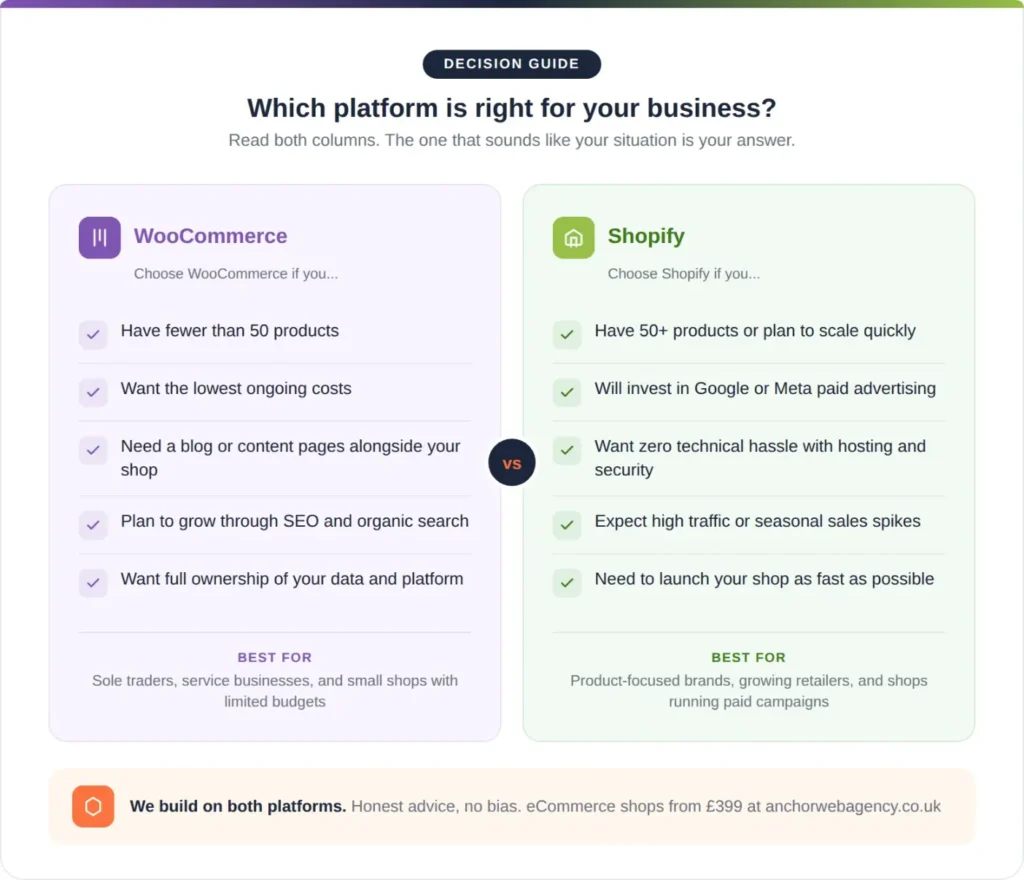
Choose WooCommerce if:
- You have fewer than 50 products
- Your marketing budget is limited and you’ll rely on organic search
- You need a website that combines content (blog, services) with an online shop
- You want full ownership of your data and platform
- You want the lowest possible ongoing costs
- You plan to use SEO as your primary growth channel
Choose Shopify if:
- You have 50+ products or plan to scale your catalogue quickly
- You’ll invest in paid advertising (Google Ads and Meta Ads) to drive traffic
- You want the simplest possible day-to-day management
- You expect high traffic volumes or seasonal spikes
- You don’t want to think about hosting, security, or technical maintenance
- Speed to launch is your top priority
Not sure? That’s completely normal. The best way to decide is to talk through your specific products, budget, and growth plans with someone who builds on both platforms. At Anchor Web Agency, we’ll give you an honest recommendation based on what suits your business, not what suits us. We build on whichever platform is the better fit.
What Does a Professional eCommerce Website Cost?
You don’t need to spend thousands to get a professional online shop. At Anchor Web Agency, eCommerce packages are designed specifically for UK small businesses:
- Starter Shop (£499): WooCommerce or Shopify setup, up to 10 products, mobile-responsive design, Stripe and PayPal checkout
- Growth Shop (£999): Up to 50 products, custom design, advanced filtering, multi-gateway payments, discount codes
- Enterprise Shop (£1199): Unlimited products, fully custom design, complete site architecture, advanced integrations
Every package includes platform setup, product uploads, payment and shipping configuration, and full training so you can manage your shop confidently. We handle everything from store design to shipping setup to payment integration.

Want to see examples of our eCommerce work? Visit our portfolio or get a free quote and tell us about your products.
Frequently Asked Questions
Is WooCommerce or Shopify cheaper for UK small businesses?
For small shops with fewer products and lower traffic, WooCommerce is typically cheaper over two to three years because there’s no monthly platform subscription. For larger shops with high traffic, Shopify’s bundled hosting and managed infrastructure can actually work out more cost-effective when you factor in the hosting upgrades WooCommerce would need. Total costs depend on your specific product range and traffic volume.
Can I switch from WooCommerce to Shopify (or vice versa) later?
Yes, migration between platforms is possible. However, it requires careful planning to preserve your SEO rankings, redirect URLs properly, and transfer product data and customer information. It’s significantly easier and cheaper to choose the right platform from the start, which is why getting honest advice before you build matters.
Which platform is better for SEO in the UK?
WooCommerce has a natural SEO advantage because it runs on WordPress and supports powerful SEO plugins like Rank Math. URL structures are more flexible, and content marketing integrates seamlessly. Shopify’s SEO has improved but still has structural limitations. For businesses where organic search is the primary growth channel, WooCommerce is the stronger choice.
Do I need a developer to run a Shopify or WooCommerce store?
Shopify is designed so non-technical business owners can manage their store independently. WooCommerce requires more technical knowledge for setup and maintenance, but once professionally built, day-to-day product and order management is straightforward. Both platforms benefit from professional setup to ensure everything is optimised from the start.
Does Shopify charge extra transaction fees?
Yes. If you use a third-party payment gateway instead of Shopify Payments, Shopify charges an additional 0.5% to 2% per transaction on top of your normal card processing fees. This applies to every sale. Using Shopify Payments (powered by Stripe) avoids this extra charge. WooCommerce never charges platform transaction fees.
Can Anchor Web Agency build my shop on either platform?
Absolutely. Unlike agencies that only work with one platform, we build on both WooCommerce and Shopify. We’ll recommend whichever platform genuinely suits your business based on your products, budget, and growth plans. No bias, no hidden agenda. eCommerce packages start from £499.